5. Péron and Freycinet’s nomenclature as an embodiment of the new French national narrative Back to Findings

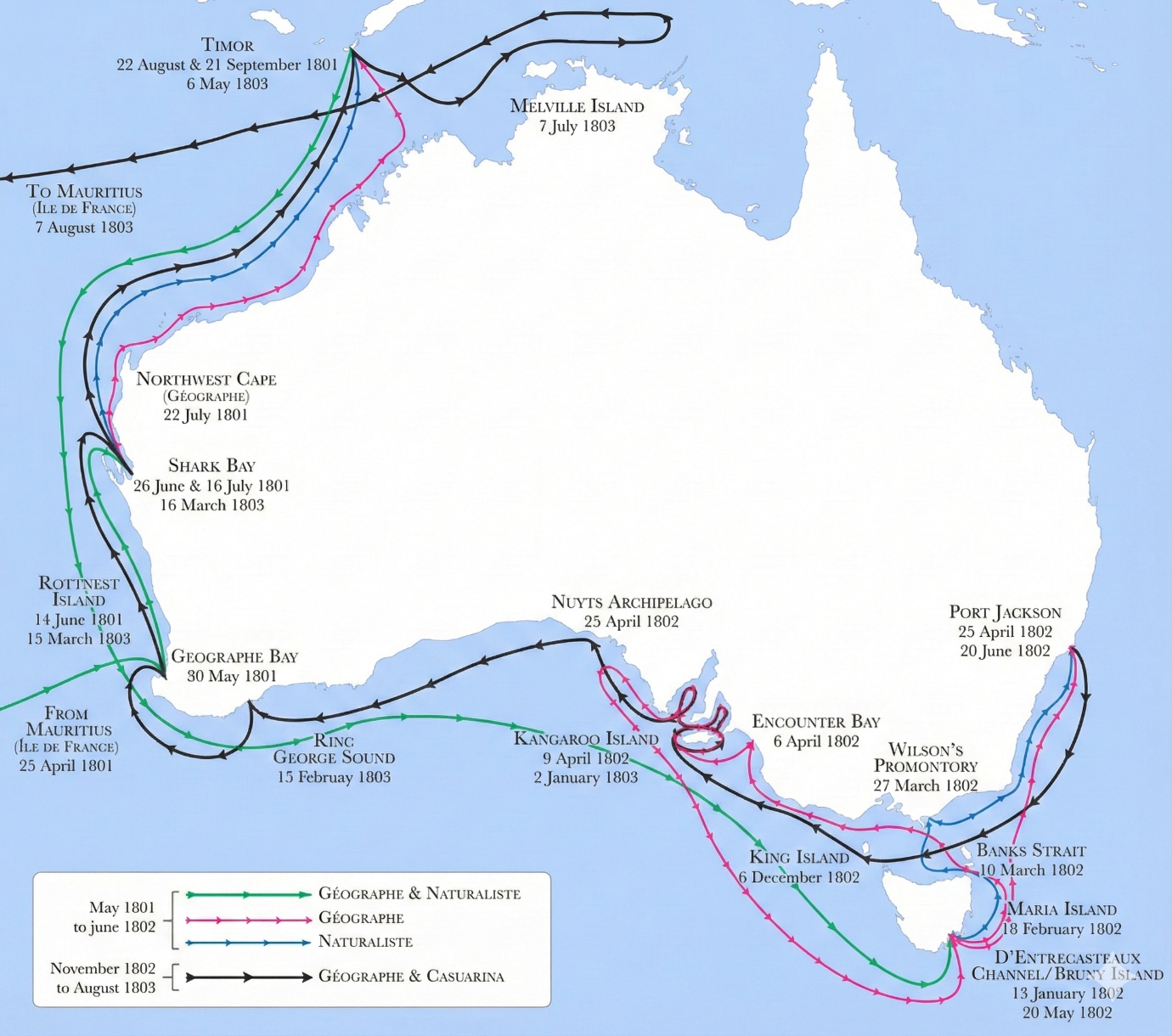
The itinerary followed by the Baudin expedition

As Baudin’s voyage was dedicated to science, and not war, the commander was provided with a British passport that allowed his two corvettes [frigates] to pass through the British blockade of the French coasts, despite Britain and France being at war. However, the British authorities were concerned about Baudin’s mission as they had newly colonised New South Wales and were contemplating future settlements on land the Baudin expedition was assigned to explore. Hence, the navigator Matthew Flinders was tasked by the British admiralty in command of the HMS Investigator with the mission to circumnavigate the South Land (Australia) and to survey its unknown coasts. Péron and Freycinet’s nomenclature bears witness to the ongoing rivalry between the French and the British in giving names to places that clearly exalt their own nation and authorities.

As the departure of the ships from their stopover at Isle de France (Mauritius) was much delayed by the red tape and the unhelpful attitude of the authorities, Baudin arrived in what are now Australian waters during the season of rain, storms, and shortened days. For this reason, the captain changed his schedule, starting his survey along the west coasts of New Holland, parts of which had already been visited in the seventeenth century by the Dutch, instead of the yet unknown south coast. The Dutch had divided the western part of New Holland into geographical regions to which they had given Dutch names (for example, the name 'Landt van de Leeuwin/The Land of the Leeuwin after the ship Leeuwin captained by Jan Fransz who charted its coast in 1622). The Baudin expedition surveyed this coast in more detail, naming uncharted geographical features such as the Baie du Géographe (Geographe Bay) after one of the voyage’s corvettes. Having surveyed the coast of western Australia, Baudin continued for a stopover at Timor. From there he sailed directly to Tasmania where he extensively explored the eastern parts of the island coastlines, assigning many place names to the localities he visited. It was not until March 1802 that Baudin started a running survey of the unknown southern coast of the continent, starting from the East. To his great surprise, on the 8–9 April, off what is today the coast of South Australia, he sighted the ship commanded by Flinders, who had already started the exploration of this coast, but sailing from the west. The encounter between the two captains has been described in many publications which tell us that they exchanged information with great civility but also misunderstanding and bitterness on the French side. The fact that Baudin and his crew had a British rival who had already completed part of the French discovery mission was a blow to him and a great disappointment. Péron and Freycinet attempted to make up for these missed opportunities by assigning an unusual number of Napoleonic names to the south coast and to confirm that their ships had visited and charted these shorelines.

After completing his survey of parts of Australia’s southern coast, Baudin headed east again for a long stopover in Port Jackson (June–November 1802) to provide rest for his sick crew and to purchase a schooner suitable for close inshore surveys. Following his departure from Sydney, Baudin revisited Tasmania and sent parties to survey King and Hunter Islands in Bass Strait in December 1802. In January–February 1803 the expedition returned for a second time to further explore the south coast of Australia. Baudin was the ‘first’ to circumnavigate Kangaroo Island, which he named Île Borda, and which Péron and Freycinet renamed Île Decrès. Baudin sent his chief geographer on missions to explore what he named the Golphe de la Misanthropie and Golphe de la Mélomanie, renamed later by Péron in honour of the imperial couple, Joséphine and Bonaparte. However, it was Flinders who had 'the priority of discovery', and he finally named them the Gulf St Vincent and Spencer Gulf.

In March–April 1803, the expedition surveyed once more the west coast of Australia to check and complete previous bearings and coordinates of the geographical features they had ‘discovered’.

The routes of the Géographe, the Naturaliste and the Casuarina following the two campaigns of the voyage, the first campaign in 1801–1802 shown in grey, green and red lines, and the second campaign in 1802–1803 in black lines.

Source: The Baudin Legacy Project

Baudin expedition track chart
Baudin expedition track chart — Source: The Baudin Legacy Project

See also the voyage timeline

A nomenclature mirroring the spirit of France during the Napoleonic era

In 1804–1805, in Paris, as a prejudicial press expressed criticism of the late and rather unjustly maligned Baudin, the promotion of his successful voyage became difficult. Péron took it upon himself to give the credit for the expedition’s achievements to the Navy Minister, Denis Decrès, who then appointed Freycinet to edit the atlas of the voyage, while the Minister of the Interior, Jean-Baptiste de Nompère de Champagny, entrusted Péron with the writing of the official account of the expedition. Napoléon authorised the publication of these volumes in 1806.

The historical narrative of the voyage, titled Voyage de découvertes aux Terres Australes exécuté sur les corvettes le Géographe, le Naturaliste et la Goëlette le Casuarina pendant les années 1800, 1801, 1802, 1803 et 1804, was published in two volumes, in 1807 and 1816. The first edition of the first volume was associated with the publication of an illustrative atlas in two volumes. The first volume of the historical atlas gathered drawings and portraits from the expedition’s artists, Charles Alexandre Lesueur and Nicolas Petit, that illustrate vividly Péron’s text. The second volume contains fourteenth charts, including the first complete map of Australia, by Freycinet, bearing the date 1811.

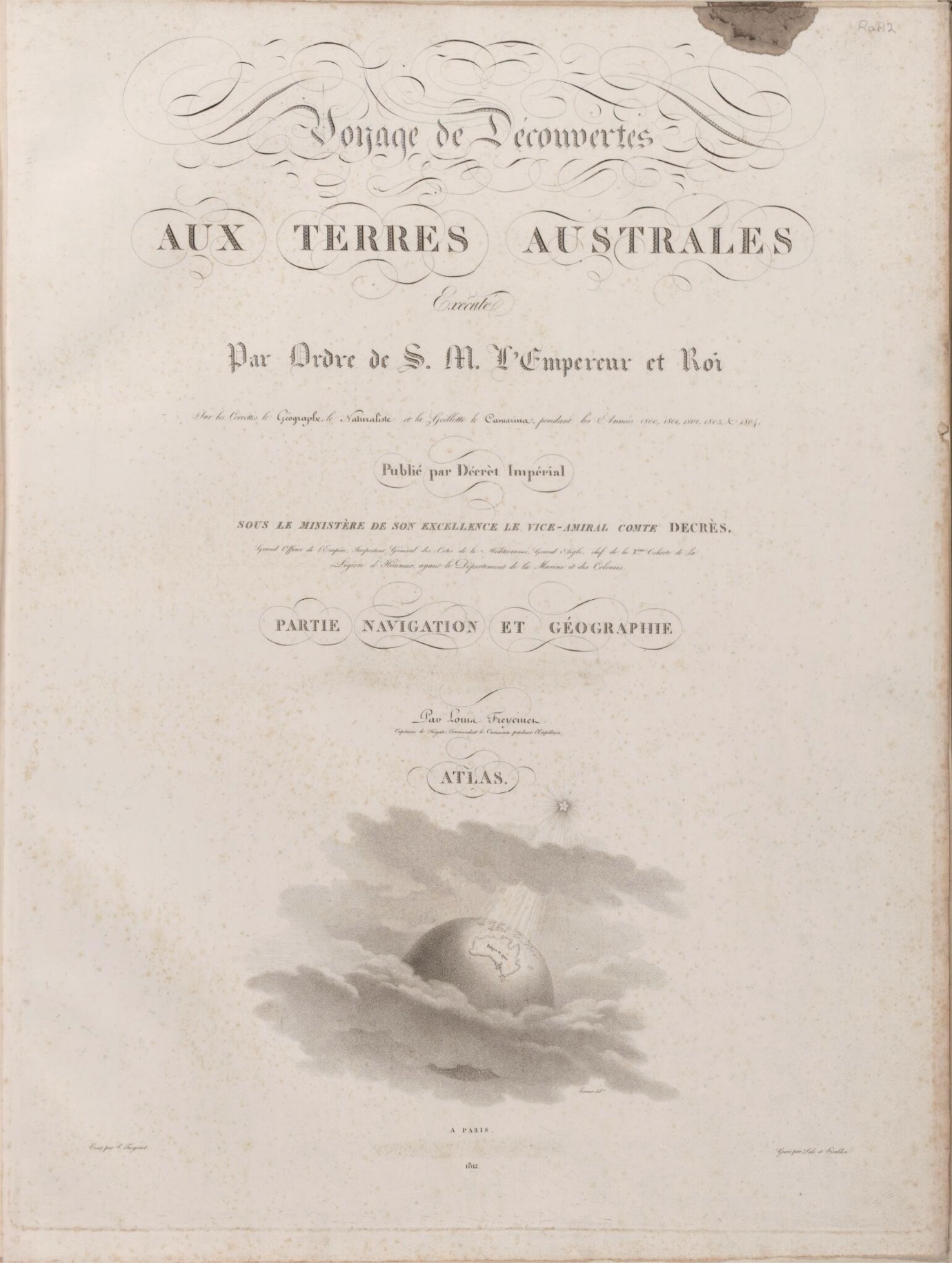
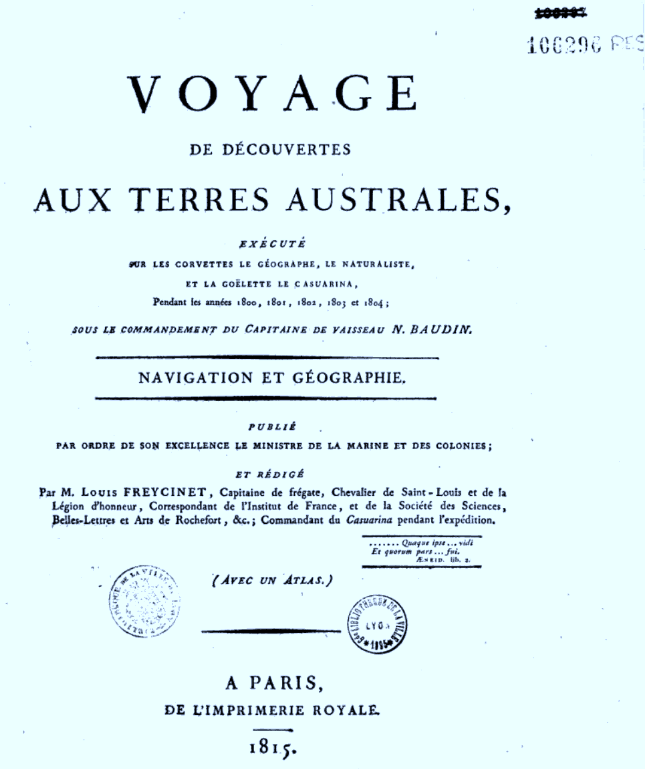
Péron died before the publication of his second volume of the historical narrative of the voyage, completed by Freycinet, and first issued after the fall of the Napoleonic empire. In 1812, Freycinet also completed the compilation of the charts of a more detailed nautical and geographical atlas, in which all the selected place names are shown. This later atlas signed 'Louis Freycinet capitaine de frigate commandant le Casuarina pendant le voyage' ('Louis Freycinet, captain, in command of the Casuarina during the voyage'), differs from that of the d'Entrecasteaux expedition in that it does not prominently feature the name of its commander, Baudin, on its first page and in its title. Though, in the nautical and geographical account published in 1815, that complements this atlas, Freycinet, under pressure from his superiors in the navy, reintroduced the name of his commander in the title.

The nomenclature’s place names can be tracked in these successive publications.

First page of the Voyage de découvertes aux Terres Australes partie navigation et géographie by Freycinet, L. (1812 [sic, published in 1815]), Atlas. de l'imprimerie royale.

First page of Voyage de découvertes aux Terres Australes, Freycinet (1812/1815)
Voyage de découvertes aux Terres Australes — Freycinet (1812/1815)

Source : National Library of Australia
Confident in the goodwill of the Napoleonic regime and of their now more respected place in the scientific community, Péron and Freycinet worked with enthusiasm on the account of the voyage and the changes to its nomenclature of places ‘discovered’ by the French, giving priority in their selection to scientific authorities and national icons who, at the time, made the nation proud. Napoléon was developing his expansionist plans, while the revolutionary ideals were shifting. The emperor, on the one hand, set aside the revolutionary and democratic notions of liberty and equality that had become too restrictive to serve his purposes while, on the other hand, giving the notion of fraternity a strong national direction in which he himself embodied the role of the gifted leader of the great French nation. With the coronation of Napoléon and his first wife, Joséphine (December,1804, at Notre Dame de Paris), the emperor re-established a strict etiquette where officers and scientists became part of a hierarchical order of precedence, mirrored in Péron and Freycinet’s choice of place names.

Hence, Péron and Freycinet re-aligned the voyage’s nomenclature with Napoléon’s politics and ideals, avoiding any reference to revolutionary leaders and focussing mainly, apart from a few personal choices, on the most officially acknowledged scientific, cultural, military and political actors of the nation.

Overall, three quarters of the place names recognise personalities whose actions or works were seen as a tribute to the French people who made up what became known since the French Revolution as the ‘Nation’. About half of them (229) were representative of French knowledge and culture, comprising the names of the French scientists and, to a lesser extent, the names of French literary and artistic figures. The second important class of place names was representative of person from the political, administrative and military spheres, including the names of past and contemporary French senior officers (158), plus, not surprisingly, those of Napoléon and members of his extended family (25). The names Bonaparte and Napoléon were assigned to the most significant geographical features discovered on the voyage. This category also included some names alluding to French military victories (29).

A further sixteen per cent of the place names (99) honoured crew members and referred to the ships engaged in the voyage. Some of the crew members were generously acknowledged with several place names, especially Péron himself and the geographer of the expedition, Charles Boullanger (4 place names each), the artist Charles Lesueur, the botanist Jean Baptiste Leschénault, the second geographer Pierre Faure, and Louis Freycinet (3 place names each). In contrast to the d’Entrecasteaux expedition, the undoubted achievements of the commander of the later expedition, Baudin, were not acknowledged with a single name. Jacques Félix Emmanuel Hamelin, his second in command, was honored with two place names in Western Australia.

Only eight per cent of the place names (46) describe the geography or natural history of the visited coasts.

The place names that reflect the central role played by scientists in French maritime voyages and national institutions

Over and above the scientific nature of the voyage, the importance of choosing place names to pay tribute to persons versed in the sciences reflects the high regard in which French officers like Freycinet, and naturalists like Péron held scientific knowledge and methods.

Both recognised the names of scientists who had contributed directly or indirectly to the development and modernisation of the French navy. Although the French Revolution weakened the navy through the forced exile of most officers, who faced possible execution due to their aristocratic origin, and by the closure of the big maritime schools where officers were traditionally trained, this scientific culture was still passed down from senior officers to naval cadets such as Freycinet. Admittance for service in the navy required applicants to pass entry tests by answering questions on nautical theory and practice. Promotion to midshipman involved further exams that assessed a cadet's knowledge 'on all branches of mathematics applied in navigation'. Hence the nomenclature includes the names of many mathematicians whose research and publications were familiar to naval officers, plus the names of the editors of the two major 18th century textbooks of mathematics used as primary references in the navy.

This choice of names also mirrors the emperor’s penchant for mathematics and physics. In his youth Napoléon dreamt of becoming a new Galileo or even a Newton. More generally, Napoléon Bonaparte greatly valued scientific competence, and became as early as 1797 a member of the Institut National des Sciences et des Lettres (see the glossary), the national institution which replaced the old academies of sciences, abolished by the Revolution because of their monarchic origins. At the Institut, Napoléon met famous scientists such as the mathematicians Gaspard Monge and Pierre-Simon de Laplace, and the chemist Claude Berthollet. Under Napoléon ‘s command they all took part in the campaign of Egypt (1798-1801) to scientifically investigate the history and geography of the region and to evaluate its various potentials. These scientists, with other colleagues were among the founding fathers of the new Ecole Polytechnique (see the glossary). Napoléon was deeply committed to the Polytechnique and offered scholars at this institution the opportunity to participate in the direction or management of the country, with the aim of developing a methodical and consistent political programme. Some of them became his ministers (Laplace, Fourcroy). Others became directors of major institutions and elite schools, such as Gaspard Clair François Marie Riche de Prony, who became director of the Ecole Nationale des Ponts et Chaussées (the National School of Civil Engineering), or Jean Baptiste Joseph Delambre who was appointed director of the Paris Observatory, or Louis-Bernard Guyton De Morveau and Monge both successive directors of the Polytechnique. All these names are included in the nomenclature of Péron and Freycinet.

Some other scientists were members of the recently established Bureau des Longitudes (Board of Longitude, see the glossary). They were keen to introduce the Decimal system to the navy and were all assigned at least one place name. These members published a favourable review of Freycinet's work, with comments by Delambre and others correcting errors relating to the coordinates of places. They also compared data of geographical coordinates and their accuracy with that from the d’Entrecasteaux, Baudin and Flinders expeditions.

Similarly, Péron and Freycinet’s nomenclature pays tribute to past generations of mathematicians and astronomers who were inspired by each other’s theories. For example, in South Australia the naming of Baie Pascal, Cap Fermat and Cap Bernouilli after Blaise Pascal, Pierre de Fermat and Daniel Bernouilli, respectively, recognises the work of three mathematicians who developed the theory of the probability and variability applied by naval officers and hydrographers to calculate positions at sea. The nomenclature also epitomises teams involved in major scientific research; for example, Charles Marie Lacontamine and Pierre Bourguer who contributed to the solution of the geodesic controversies during the 18th century about the shape of the Earth and whether the poles were flattened or rounded. Their names were given to two neighboring islands in South Australia. Both went to Peru to measure the meridian arc between Quito and Cuenca on the equator, while Pierre Louis Moreau de Maupertuis, together with Alexis Clairaut made an expedition to Lapland to determine the shape of the North pole. The work of all these mathematicians was recognised by giving their names to places on the coastlines of what is now known as Eyre Peninsula.

The end of the eighteenth century was a time when, to use current terminology, nautical sciences and technology were working closely together to improve naval shipbuilding and search for reliable methods to accurately calculate longitude at sea. Freycinet and Péron’s nomenclature acknowledges the names of talented engineers and instrument makers who invented or improved new methods in cooperation with scientists and naval officers. Cap Bélidor honours a French engineer, author of L'architecture hydraulique (published in four volumes from 1737-1753). Cap Sané (Kangaroo Island) honours Jacques-Noël Sané who conceived standardised designs for ships. Cap Lenoir honours Etienne Lenoir who made instruments such as the repeating circle for measuring distances used during the d’Entrecasteaux and Baudin voyages. Cap Berthoud in Tasmania and ÈŠle Berthoud in Western Australia honors the Swiss-born Ferdinand Berthoud who worked for the French navy in the development of sea chronometers. The Baudin expedition carried four chronometers made by Berthoud; numbers 31 and 38 were assigned to the Géographe, and the two others to the Naturalist, with the officers given the task of testing their accuracy. Berthoud’s Traité des horloges marines, de la mesure du temps ou supplément au Traité des horloges marines, 1787 and Traité des montres à longitude were both in the ships' libraries.

The nomenclature also commemorates scientists such as mathematician Condorcet and chemist Lavoisier whose lives were taken by the Terror (see the glossary) with its indiscriminate repression and expeditious trials. By the same token, nomenclature also condemns this paroxysmal revolutionary moment.

In tune with the geographical mission of the voyage the names of several iconic geographers who edited well-known atlases were recognised. A bay was named after the cartographer Jean Baptiste Bourguignon d'Anville. A cape and an island pay tribute to members of the Cassini family, authors of the first general map of France, prepared by using the triangulation method. Jean Nicolas Buache (1741 1825), who had been the king’s geographer and was advising Freycinet at the Dépôt des Cartes in Paris, was acknowledged with a cap and a harbour in Tasmania and with an island in Western Australia. The geographer Edme Mentelle (1730-1815), a member of the Institut, was also honoured with a cape in Western Australia. However, it was Charles-Pierre Claret de Fleurieu, a geographer and cartographer, who was also an officer in the navy, who was accorded the most place names, with a bay, a river and an island in Van Diemen’s Land (Tasmania) and a large peninsula in Terre Napoléon, on the southern end of the Gulf Joséphine in today’s South Australia. This was to be expected, as Fleurieu had played a crucial role in several ways in the voyage commanded by Baudin. He was responsible for drawing up its general instructions and itinerary and was a member of the commission that prepared the voyage. He was also a member of key scientific institutions, especially l’ Institut and the Bureau des longitudes that assessed the voyage’s scientific results through reports and reviews. He was in a close relationship with the minister of the navy at the time of the expedition’s return, and was familiar with the Dépôt des Cartes et Plans, where he was editing the charts of his major Atlas of the Kattegat and the Baltic, at the same time that Freycinet was compiling the charts of the voyage.

Another important mission of these voyages of discovery was to collect samples of flora, fauna and rocks and minerals that were handed over, identified and classified after the return of the expedition by prominent scientists who were members of the Museum National d’Histoire Naturelle (see the glossary), like André Thouin, and René Louiche-Desfontaines, who were also rewarded with a place name. Péron also paid homage to past botanists who had contributed to the classification of plants and animals into genera and species, such as the seventeenth century botanist Joseph Pitton de Tournefort and the dynasty of the Jussieu family. Péron pays tribute to Antoine Laurent de Jussieu, who was part of the commission that organised the Baudin voyage and who also proposed the classification of three groups of plants according to their number of cotyledons.

Other scientists who were contemporaries of Péron comprehended and classified the natural world through the notions of evolution, non-fixity of species and 'transformism' (the gradual transformation of species through generations), and have their names also commemorated in the nomenclature. They include those of Georges-Louis Leclerc, known as Comte de Buffon, Geoffroy Saint-Hilaire, Bernard de Lacépède and Jean-Baptiste Lamarck. The theories of these naturalists diverged from the notion of a fixed order developed by Péron’s patron, Georges Cuvier, who was however rewarded with three place names. In so doing, the nomenclature brings to light the major scientific debates of the time.

In addition, Péron dedicated some place names to some unfortunate botanists who worked tirelessly in the service of their nation. Philibert Commerson, the naturalist on Antoine de Bougainville’s voyage and other explorations who died before he could publish the results of his work; Robert de Lamanon, who died during the La Pérouse expedition; Joseph Dombey, who was sent on an official mission to the United States but was captured by privateers and imprisoned in Montserrat (a British island in the West Indies), where he died in 1794, and Pierre Sonnerat who was imprisoned by the British at Yanaon (India) for twenty years.

Several entomologists are honored, such as Pierre-André Latreille, who worked at the Museum National d’Histoire Naturelle and assisted Lamarck in his public lectures on invertebrates, and Guillaume-Antoine Olivier, who gathered a large collection of specimens during his travels in the Ottoman Empire, Egypt and Persia. Unusually, the naturalist Louis-Jean-Marie Daubenton (1716 –1800), who worked with Thouin, Jussieu and Desfontaines, received a place name in Péron’s narrative (Baie Daubenton in Victoria), but not in Freycinet’s atlas.

The nomenclature also pays tribute to scientists engaged in new fields of research, such as geology, that contributed to the vitality of science in France. The term 'geology' was first used in the mid-eighteenth century, following the introduction of new scientific methods in the investigation of the Earth’s history. It had formerly been included under the umbrella term of natural history. This led to the formulation of new theories and to animated debates. Faujas de Saint-Fond and Déodat de Dolomieu. Both geologists were honoured with place names, as was René Just Haüy (1743-1822), a noted mineralogist and crystallographer. Horace Bénédict de Saussure, a distinguished Swiss geologist who had investigated the origins of the Alps, was also rewarded with a place name.

A few other place names represent the development of another emergent discipline, which Péron termed 'anthropologie' in a memoir submitted in June 1800 to Cuvier and read at the Institut. Péron named two localities after leading scientists who were involved in the development of the new discipline: Joseph-Marie Dégérando who provided the Baudin expedition with specific instructions and questionnaires to instruct them in the observation of the 'sauvage', and Constantin-François Chassebœuf de La Giraudais, Comte Volney who suggested methods for observing societies based on Republican ethics and duties.

However, the place names relating to natural history total just under half of those linked to mathematical and nautical sciences and cover a wide range of disciplines. This strongly reflects the change in emphasis in the sciences during the Napoleonic period, which led to the establishment of a hierarchy among disciplines, with mathematics and physics seen as the 'exact' sciences, at the top. The collective field of the study of natural history was divided into new specialised disciplines, such as biology, comparative anatomy, geology, anthropology and zoology. Over time, the various disciplines were further subdivided into specialist fields of study. The term geology, for example, includes the subjects of stratigraphy, mineralogy, palaeontology and volcanology, among many others, while branches of zoology are named vertebrate and invertebrate zoology, comparative anatomy, animal physiology and more. In addition, a new system of classification of plants and animals was developed.

In that respect, the collection of the names of scientists which Péron and Freycinet include in their nomenclature testify to the significance, configuration and vitality of French sciences during the Napoleonic period.

The Place names honouring French literature and art

Attaching many names of people associated with literature and the arts to place names in other countries was unusual. However, atypically, Péron and Freycinet included in their list the names 64 men and women of letters from the sixteenth to the early nineteenth centuries, whose works regained popularity during or after the French Revolution. Chronologically, three sixteenth century humanists philosophers whose fame was revived by the Revolution and the Empire received a place name, while 26 place names were respectively and evenly given to the emblematic philosophers and authors of the seventeenth and eighteenth centuries who promoted French philosophy and literature. Women of letters were equally included, especially those who developed new literary genres dear to the empress Joséphine. Yet, none of the well-known women of letters who lost their life during the Terror defending their ideals of freedom and equality at the time when Joséphine was herself incarcerated (Mmes Roland and Olympe de Gouge), and none of the contemporary famous but polemical women of letters such as Mmes de Récamier and Germaine de Staël, who were forced into exile, were recognised in Péron and Freycinet’s nomenclature because their political thinking was at odds with Napoléon’s imperial views, at the time when the emperor authorised his government to sponsor the official publications of the voyage.

Following their established practice, contemporary artists, who Napoléon had assigned to glorify his reign through their artwork, together with classical or neoclassical masters of painting who trained or influenced them, also obtained a place name.

To sum up, Péron and Freycinet’s choice of names established a nomenclature of authors and artists who contributed most to the glory of the nation and the empire and ignored those whose ideas directly or indirectly contradicted the Napoleonic regime.

The place names honouring administrative, military and Navy officers

Administrative officers and ministers

The nomenclature also pays respect to the political and military figures regarded as being role models when serving the nation. Altogether 152 place names refer to the names of military and state officers. Their distribution is equally balanced, with about a third of place names dedicated to administrators and ministers, another third to officers of the Army, and the last third to naval officers. Within each of these categories, a third served during the Napoleonic period, while two thirds had served past kings. Personalities who had been involved in the Revolution are not represented, as their revolutionary ideals were contrary to Napoléon’s ascension to the imperial throne.

The place names accorded to Napoléon’s administrative and government officials included advisers and ministers who had served or were still serving under him, and others who had served under previous regimes. Among Napoléon’s ministers selected for this honor were: Jean-Baptiste de Nompère de Champagny and Emmanuel Crétet from the Ministry of the Interior (the former from 1804 to 1807, the latter from 1807 to 1809), who were instrumental in financing the publications of the historical narrative of the voyage, together with Napoléon’s long- term minister for the navy and the colonies, Denis Decrès, who arranged the financing of the publication of the nautical and geographical work.

The nomenclature also pays tribute to historical figures of past centuries whose achievements strengthened the French state and nation, such as the first ministers of Henri IV, Louis XIII and Louis XIV, respectively Maximilien de Béthune, duc de Sully, Cardinal Armand Jean du Plessis, duc de Richelieu and Jean-Baptiste  Colbert, whose policies had been crucial to the development of the French navy and to colonial trade and the empire. Sébastien Le Prestre de Vauban, considered the greatest military engineer of his time and admired by Napoléon, was also given a place name.

By contrast, the names of only three senior officials from the reigns of Louis XV and Louis XVI (until 1789) appear in their nomenclature, Joseph-François Dupleix, Antoine-Jean Amelot de Chaillou and Chrétien-Guillaume de Lamoignon de Malesherbes, although other ministers were actively involved in the redevelopment of the French navy, enabling it to compete with the British navy. This more favourable recognition given to governmental and political figures of the 17th century compared to that of their successors in the 18th century is an indication that reconciliation of the nation with its immediate monarchical past when Louis XV and Louis XVI reigned was not yet an option. It also shows that the nomenclature helped to facilitate the introduction of a new historical narrative, according to which the reputation of purposely chosen officials who had served in earlier times but had often been forgotten, was revived and elevated by Napoléon to national hero status, which contributed to the formation of a new image of the nation among its citizens. Joseph-François Dupleix, for example, gained a reputation as a genius during the Napoleonic Empire, because in his role as an administrator in India he had confronted the British, who Napoléon regarded as his worst enemy. During his own lifetime Dupleix had been disregarded and was forced by Louis XV to resign his position.

Military commanders

This new national narrative was instrumental in bringing to greater notice the names of many French army officers, who now came to be regarded as heroes, especially those who had fought with Bonaparte in his successful Italian campaign against European coalition forces hostile to revolutionary France, which began in 1796. Many of these officers later became Marshals of the French Empire and/or Comte d’Empire. Fallen heroes of the battlefields were also honoured.

Among past military commanders, Henri de La Tour d'Auvergne, known as Turenne, was remembered because Napoléon had praised his military genius. The emperor held two knights from the 14th to the 15th centuries, known as Bayard and Duguesclin (or Du Guesclin), in high esteem, and reinforced the memory and cult of Jeanne d’Arc, venerated by the French as a martyr, as well as that of Jeanne Hachette, a woman who in 1472 is said to have fought valiantly and heroically with just an axe to keep the city of Beauvais in the hands of the king of France.

Navy officers

The nomenclature pays homage to the chief Navy officers who were contemporaries of Péron and Freycinet and to past seventeenth century’s naval officers who took part in fearsome sea battles. A range of naval officers from the 18th century who had contributed in some way to the modernisation of the French Navy and officers who saw service in the Levant Fleet were hand-picked by Péron and, principally, by Freycinet. These included the tactician Luc Urbain du Bouexic, Comte de Guichen, the strategist Pierre André de Suffren de Saint Tropez, Bailly de Suffren, referred to by the British as “Admiral Satan”, Roland-Michel Barrin, Marquis de La Galissonnière, who was also a man of science and contributed to the development of an educated and trained navy, and Charles Louis du Couëdic, who fought against the English during the American Revolutionary War. Also honoured with place names were officers who saw service in the Levant Fleet: Anne Antoine, Comte d’Aché (Daché) and Bertrand François Mahé, Comte de La Bourdonnais.

The place names paying homage to Napoléon and his relatives

Finally, 25 place names honored the emperor and his family, especially in South Australia (19), which was the contested coast, where both Matthew Flinders and the chroniclers of Baudin’s voyage claimed the right of first discovery. Amidst the confusion of the situation, and perhaps taking some advantage from it, Péron and Freycinet named the whole length of the previously uncharted coast, that used to be known as the 'unknown coast', 'Terre Napoléon', and its two major gulfs, Golfe Napoléon (Spencer Gulf) and Golfe Joséphine (St Vincent Gulf).

The large gulf on the north western coast of Western Australia was attributed to Napoléon’s brother Joseph (Golfe Joseph Bonaparte). The name has been retained in its AusE version as Joseph Bonaparte Gulf or more commonly as Bonaparte Gulf. Napoléon’s other brothers, Louis and Jérôme, his sisters Eliza, Pauline and Caroline, his adopted children from Joséphine, Hortense and Eugène, were all given place names grouped in the western part of Terre Napoléon and the two South Australian gulfs. The name of Napoléon’s mother, Laetitia, as well as Joséphine’s niece and stepdaughters, Stéphanie and Adèle are also part of this nomenclature. The names of Joseph and Eugène's spouses, Julie and Amélie, have been given to places next to those bearing the names of their husbands. Joséphine’s lady-in-waiting, Adélaïde de La Rochefoucauld, was given a place name in Golfe Joséphine (Cap La Rochefoucault). Lucien Bonaparte is Napoléon’s only brother absent from the nomenclature. He had been banned by Napoléon from any mention in the list of princes of the imperial family because of his opposition to the emperor and despite his astute action during the coup d’état of the 18 Brumaire (9 November 1799) that saved Napoléon Bonaparte and gave him control of the situation.

5. La nomenclature de Péron et Freycinet comme expression du nouveau récit national français Retour aux enseignements

L’itinéraire suivi par l’expédition Baudin

Le voyage de Baudin, conçu comme une expédition scientifique et non militaire, bénéficiait d’un passeport britannique autorisant ses corvettes à franchir le blocus des côtes françaises. Les autorités britanniques demeuraient néanmoins méfiantes, car elles avaient déjà colonisé la Nouvelle-Galles du Sud et envisageaient de nouvelles implantations sur les terres que les Français devaient explorer. Matthew Flinders fut ainsi chargé par l’Amirauté britannique, à bord du HMS Investigator, de reconnaître et relever les côtes encore inconnues de l’Australie. La nomenclature de Péron et Freycinet reflète cette rivalité franco-britannique dans l’attribution de noms de lieux.

Retardé à l’Isle de France (Maurice), Baudin arriva en eaux australiennes pendant la mauvaise saison et modifia son programme: il commença par la côte ouest de la Nouvelle-Hollande, déjà partiellement connue des Hollandais, avant de se tourner vers la côte sud encore inconnue. L’expédition nomma divers éléments géographiques jusque-là non cartographiés (par exemple la Baie du Géographe), poursuivit vers Timor, puis explora longuement la Tasmanie. En avril 1802, sur la côte aujourd’hui sud-australienne, Baudin rencontra Flinders, qui explorait la même zone en sens inverse. La rencontre fut courtoise mais lourde d’enjeux: les Français comprirent qu’un rival britannique avait déjà couvert une partie de leur mission. Péron et Freycinet compensèrent ensuite cette situation en multipliant les noms napoléoniens sur la côte sud.

Après un long séjour à Port Jackson (Sydney) en 1802, Baudin relança ses relevés, fit explorer les îles du détroit de Bass et revint en 1803 sur la côte sud. Il fut le premier à contourner Kangaroo Island (qu’il nomma Île Borda), rebaptisée ensuite Île Decrès par Péron et Freycinet. Plusieurs golfes et lieux furent également renommés, mais Flinders imposa finalement de nombreux noms britanniques en vertu du droit de première découverte revendiqué par les Anglais.

En mars-avril 1803, l’expédition revisita la côte ouest afin de vérifier et compléter ses relèvements et coordonnées.

Routes du Géographe, du Naturaliste et du Casuarina pendant les deux campagnes du voyage (1801-1802 et 1802-1803).

Source : The Baudin Legacy Project

Carte des routes de l’expédition Baudin
Carte des routes de l’expédition Baudin — Source : The Baudin Legacy Project

Voir aussi la chronologie du voyage

Une nomenclature reflétant l’esprit de la France napoléonienne

À Paris, entre 1804 et 1805, la réception du voyage de Baudin fut compliquée par les critiques adressées au commandant défunt. Péron réorienta la valorisation de l’expédition vers ses protecteurs institutionnels, en particulier Denis Decrès (Marine) et Jean-Baptiste de Nompère de Champagny (Intérieur), tandis que Freycinet fut chargé des atlas et Péron du récit officiel. Napoléon autorisa la publication des volumes à partir de 1806.

Le Voyage de découvertes aux Terres Australes parut en plusieurs volumes (1807 et 1816), accompagnés d’atlas illustrés et cartographiques. Freycinet acheva ensuite un atlas nautique et géographique plus détaillé (publié en 1815), dans lequel la nomenclature apparaît de manière systématique. Le nom de Baudin y est moins mis en avant que dans la tradition des récits de voyage, ce qui souligne déjà le glissement éditorial opéré par Péron et Freycinet.

Les noms de lieux de la nomenclature peuvent être suivis dans ces publications successives.

Première page du Voyage de découvertes aux Terres Australes, partie navigation et géographie de Freycinet (atlas, 1812 [sic], publié en 1815).

Première page du Voyage de découvertes aux Terres Australes, Freycinet (1812/1815)
Voyage de découvertes aux Terres Australes — Freycinet (1812/1815)

Source : National Library of Australia

Péron et Freycinet, confiants dans l’appui du régime napoléonien et dans leur statut scientifique, recomposèrent la nomenclature des lieux « découverts » par les Français en privilégiant des savants, des figures culturelles et des icônes nationales. Le basculement politique entre Révolution et Empire se lit dans ces choix: les références révolutionnaires s’effacent au profit d’un ordre hiérarchisé, impérial et national, renforcé après le sacre de Napoléon et Joséphine en 1804.

Ils réalignèrent ainsi la nomenclature sur les valeurs, les priorités politiques et l’imaginaire national du régime napoléonien, en évitant les leaders révolutionnaires et en mettant en avant les figures officiellement reconnues dans les domaines scientifique, culturel, militaire et administratif.

Au total, environ les trois quarts des noms de lieux honorent des personnalités dont les actions ou les œuvres étaient perçues comme contribuant à la grandeur de la Nation française. Environ la moitié d’entre eux (229) représentaient les savoirs et la culture française (principalement des savants, mais aussi des figures des lettres et des arts). Une autre grande catégorie relève des sphères politique, administrative et militaire: officiers supérieurs anciens et contemporains (158), membres de la famille impériale (25) et noms évoquant des victoires françaises (29). Les noms Bonaparte et Napoléon furent réservés à des éléments géographiques majeurs.

Environ seize pour cent des noms (99) honorent les membres de l’équipage et les navires de l’expédition. Plusieurs participants reçurent plusieurs hommages (Péron, Boullanger, Lesueur, Leschénault, Pierre Faure, Louis Freycinet), tandis que Baudin lui-même, malgré ses réalisations, ne fut honoré d’aucun nom de lieu. Hamelin, son second, reçut deux noms en Australie-Occidentale. Huit pour cent seulement (46) des noms décrivent directement la géographie ou l’histoire naturelle des côtes.

Les savants au cœur de la nomenclature

Le poids des noms de savants dans la nomenclature reflète à la fois la nature scientifique du voyage et le prestige des sciences dans la France napoléonienne. Péron et Freycinet honorent de nombreux mathématiciens, astronomes, ingénieurs, constructeurs navals, géographes, naturalistes et membres d’institutions comme l’Institut, le Bureau des longitudes ou l’École polytechnique, perçues comme centrales dans la modernisation de l’État et de la marine.

La nomenclature fait place à des mathématiciens (Monge, Laplace, Delambre, etc.), à des géodésiens et géographes (Cassini, Buache, Mentelle, Fleurieu), à des ingénieurs et instrumentistes (Bélidor, Sané, Lenoir, Berthoud), ainsi qu’à des naturalistes, botanistes, entomologistes et géologues (Thouin, Jussieu, Buffon, Lamarck, Cuvier, Latreille, Haüy, Dolomieu, Saussure, etc.). Elle reflète aussi les débats scientifiques de l’époque (fixité des espèces, transformisme, classification du vivant) et l’essor de disciplines nouvelles comme la géologie et l’anthropologie.

Elle rend également hommage à des savants victimes des violences politiques (comme Condorcet et Lavoisier) et à des naturalistes ayant servi la science dans des conditions difficiles, parfois jusqu’à la mort, comme Commerson, Lamanon, Dombey ou Sonnerat.

Les lettres et les arts dans la nouvelle narration nationale

Plus inhabituel pour une nomenclature issue d’un voyage de découverte, Péron et Freycinet attribuèrent aussi de nombreux noms à des auteurs, philosophes et artistes français. Cette sélection privilégie des figures dont la réputation fut consolidée ou réactivée pendant la Révolution et l’Empire, ainsi que des artistes associés au prestige du régime napoléonien. À l’inverse, certaines figures intellectuelles contemporaines, jugées trop critiques du régime, furent exclues.

La nomenclature compose ainsi un panthéon culturel compatible avec le récit national impérial: elle consacre les auteurs et artistes considérés comme gloires de la nation et écarte ceux dont les idées entraient en contradiction avec l’ordre politique napoléonien.

Administrateurs, militaires et officiers de marine

La nomenclature honore aussi de nombreux serviteurs de l’État, répartis entre administrateurs/ministres, officiers de l’armée de terre et officiers de marine. On y trouve à la fois des contemporains de Napoléon et des figures plus anciennes, réinterprétées comme précurseurs de la grandeur française. Cette sélection participe à la construction d’un récit national unifié et hiérarchisé, dans lequel certaines figures des XVIIe et XVIIIe siècles sont réévaluées à la lumière des priorités de l’Empire.

Parmi les militaires, sont particulièrement valorisés les héros des campagnes napoléoniennes, mais aussi des figures plus anciennes (Turenne, Bayard, Duguesclin, Jeanne d’Arc, Jeanne Hachette). Du côté naval, Péron et Freycinet rendent hommage à des officiers emblématiques de la marine française, y compris des acteurs des grandes batailles maritimes des XVIIe et XVIIIe siècles.

Napoléon, sa famille et la Terre Napoléon

Enfin, 25 noms de lieux honorent Napoléon et sa famille, surtout en Australie-Méridionale, région disputée où Français et Britanniques revendiquaient la priorité de découverte. Péron et Freycinet nommèrent la côte encore mal connue « Terre Napoléon » et donnèrent à ses grands golfes des noms impériaux (Golfe Napoléon, Golfe Joséphine). D’autres membres de la famille Bonaparte, de l’entourage de Joséphine et des alliances impériales furent également inscrits dans cette géographie symbolique.

Cette concentration de noms impériaux sur une zone contestée montre à quel point la nomenclature fonctionnait comme un instrument de prestige national, de mémoire politique et d’affirmation symbolique française au moment où l’Empire cherchait à redéfinir la place de la France dans le monde.