Brest · 28 septembre 1791
Le départ de La Recherche et de L’Espérance
Le contexte révolutionnaire, les préparatifs à Brest et l’appareillage des deux frégates envoyées à la recherche de La Pérouse.

Départs, vies et compagnons de voyage : des récits au fil des expéditions.
Deux récits filmés consacrés aux départs de La Recherche et de L’Espérance depuis Brest en 1791, puis du Géographe et du Naturaliste depuis Le Havre en 1800.
Brest · 28 septembre 1791
Le contexte révolutionnaire, les préparatifs à Brest et l’appareillage des deux frégates envoyées à la recherche de La Pérouse.
Le Havre · 19 octobre 1800
La préparation scientifique du voyage de Nicolas Baudin et le départ des deux corvettes à destination des Terres australes.
Destins singuliers et compagnons de voyage au quotidien.
Louis Girardin — Marie-Louise Victoire Girardin · 1754–1794
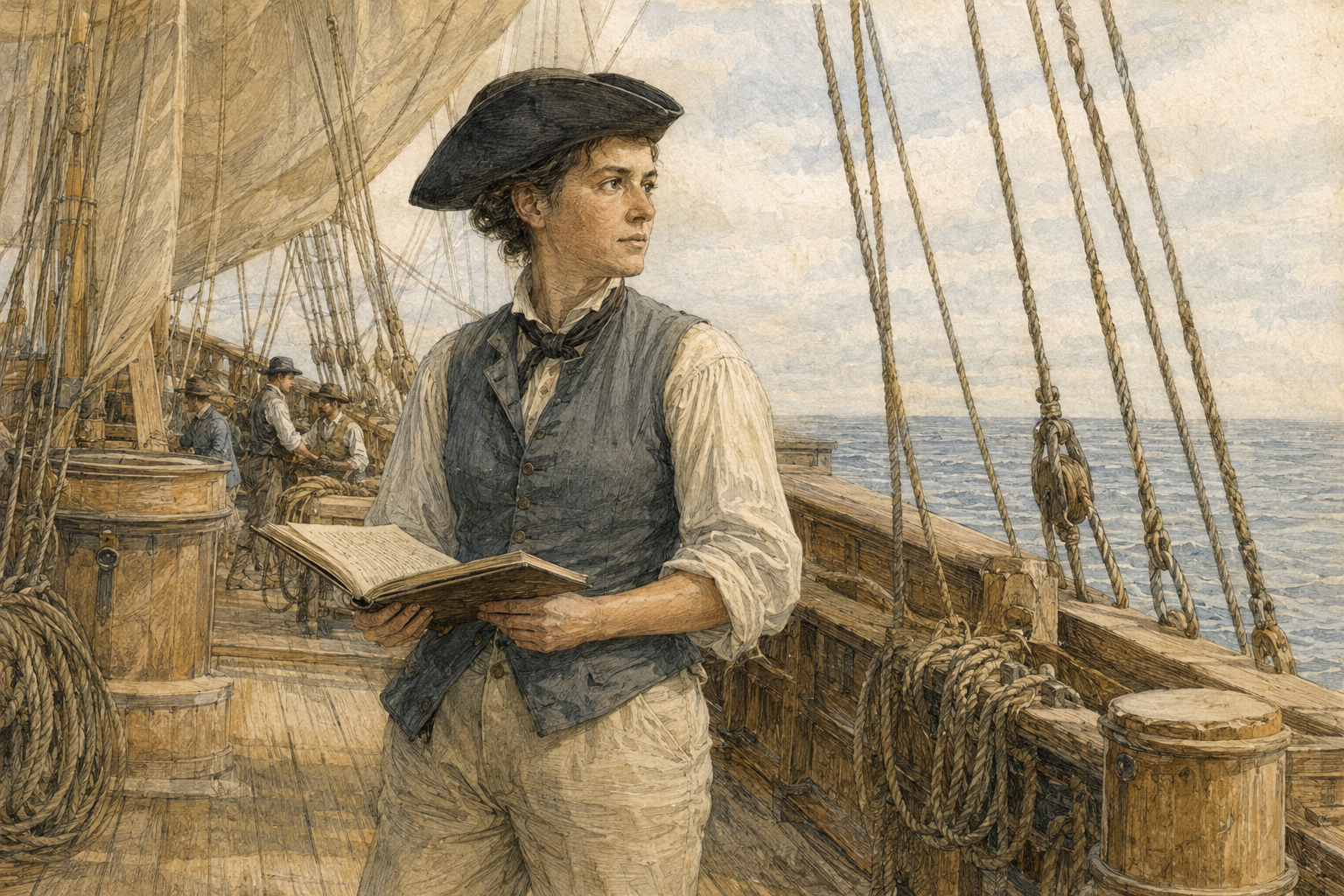
Au XVIIIe siècle, les femmes ne sont pas autorisées à embarquer sur les bâtiments de la Marine française. Cette règle explique le recours à une identité masculine : Jeanne Baret l’avait déjà fait pour participer au voyage de Bougainville. Dans l’espace clos d’un équipage exclusivement masculin, préserver une telle identité expose à une surveillance quotidienne, aux rumeurs et aux soupçons.
Fille d’un ancien jardinier royal devenu marchand de vin, Marie-Louise est veuve depuis 1781. Après la naissance d’un enfant hors mariage, elle fuit la colère de son père. À Brest, une lettre l’introduit auprès de Mme Le Fournier d’Yauville, sœur de Huon de Kermadec. Celui-ci facilite son engagement.
Sous le prénom de Louis, elle sert d’abord sur les Deux Frères, puis rejoint La Recherche en septembre 1791. Son emploi de commis aux vivres lui épargne l’examen médical et lui permet de disposer d’une petite cabine séparée. Il semble que d’Entrecasteaux ait connu son secret et approuvé son embarquement.
Girardin défend son identité masculine malgré les rumeurs. Les soupçons au sein de l’équipage deviennent suffisamment insistants pour qu’elle provoque en duel un membre de l’équipage qui met en doute son identité. Elle est blessée au bras au cours de l’affrontement.
En Tasmanie, les interrogations des habitants autochtones sur l’absence de femmes parmi les visiteurs contribuent à raviver ces soupçons. Du dimanche 10 au lundi 11 février 1793, alors que les Français rencontrent des Tasmaniens, l’officier La Motte du Portail, à bord de L’Espérance, note dans son journal de mer que ceux-ci ont du mal à croire qu’un groupe aussi nombreux puisse être exclusivement masculin et cherchent à vérifier si c’est exact. Il écrit :
« Cette recherche infructueuse qui s’est répétée à toutes nos entrevues les a laissés dans le plus grand étonnement de ne pas rencontrer de femmes parmi une aussi grande quantité d’hommes. Nous eûmes également par cette occasion de vérifier les soupçons formés depuis longtemps sur le commis aux vivres [Marie-Louise, alias Louis Girardin] de la Recherche qu’on avait lieu de croire une femme. »
Le sexe de Girardin faisait ainsi l’objet de soupçons suffisamment précis pour être consigné dans le journal d’un officier de l’expédition.
Le journal de La Motte du Portail suggère une relation possible avec l’enseigne Mérite. Tous deux meurent de dysenterie à un jour d’intervalle. Duyker situe la mort de Girardin au 18 décembre 1794, à bord du transport hollandais Dordrecht, et rapporte que le chirurgien révèle alors son sexe.
Kismy, le fidèle compagnon du zoologiste Stanislas Levillain

Kismy accompagne Stanislas Levillain, aide-zoologiste de l’expédition Baudin, transféré du Géographe au Naturaliste en 1801. Doux et caressant, le chien est aimé de tout l’équipage. Pour Levillain, c’est son « plus fidèle ami ».
Entre le 8 et le 12 juin 1801, les opérations à terre sont marquées par la disparition du matelot Vasse et par la perte de Kismy. Levillain avait prêté son chien à Milius. Effrayé par la lame, l’animal ne peut être rembarqué : les hommes doivent le laisser sur le rivage. Dans son journal, Levillain exprime sa douleur et ses larmes. Le récit ne précise pas ce qu’est devenu Kismy après cet abandon.
Cette perte est aussi celle d’un auxiliaire précieux. Levillain explique l’utilité d’un chien pour rapporter des quadrupèdes, du gibier des marais ou des oiseaux abattus dans l’eau. Son témoignage mêle ainsi l’attachement à un compagnon et les difficultés concrètes des collectes zoologiques.
Extrait du journal de Levillain (Version française modernisée)
Mon pauvre chien Kismy, que j’avais prêté par complaisance à M. Millius, lieutenant de vaisseau, qui lui était lui aussi quelque peu attaché — mon plus fidèle ami, auquel mon attachement ne faisait aucun doute —, avait pris peur de la lame et n’avait jamais voulu se laisser attraper pour être embarqué. Finalement, on avait été obligé de le laisser. Hélas, je ne puis retenir mes larmes. Mon pauvre chien, mon fidèle et vieil ami ! Il faut avoir eu un animal semblable pour comprendre la douleur que l’on ressent lorsqu’on est privé de celui auquel on était attaché !
Cette perte est considérable à bien des égards, particulièrement pour la zoologie. Comment, en effet, se procurer des quadrupèdes sans chien ? Comment rapporter une pièce de gibier des marais ? Comment, lorsqu’un oiseau aquatique a été abattu sur une pièce d’eau, récupérer l’un de ceux qui sont tombés dans l’eau ?
Hélas, il me semble encore entendre les cris et les hurlements plaintifs de ce pauvre animal. Puisse la nature lui indiquer les moyens de survivre en chassant pour son propre compte, ou en cherchant à s’attacher à quelque indigène bienveillant. Ce pauvre animal était aimé de tout le monde à bord ; il était si doux et si affectueux que tout l’équipage l’aimait beaucoup.
Je ne puis en parler davantage : mes yeux se remplissent à nouveau de larmes et je n’y vois plus assez pour continuer. Pour la première fois que je m’attache ainsi à un animal, je suis bien malheureux !
Récit repris de la fiche détaillée de Levillain, d’après son journal.
Journal de Stanislas Levillain — The Baudin Legacy Project ↗
Departures, lives and travelling companions: stories from across the expeditions.
Two film accounts of La Recherche and L’Espérance leaving Brest in 1791, followed by Le Géographe and Le Naturaliste leaving Le Havre in 1800.
Brest · 28 September 1791
The revolutionary context, the final preparations in Brest, and the departure of the two frigates sent in search of La Pérouse.
Le Havre · 19 October 1800
The scientific preparation of Nicolas Baudin’s voyage and the two corvettes’ departure for the Southern Lands.
Remarkable lives and travelling companions in the everyday world of the expeditions.
Louis Girardin — Marie-Louise Victoire Girardin · 1754–1794
In the eighteenth century, women were not permitted to serve aboard ships of the French Navy. This prohibition explains the adoption of a male identity: Jeanne Baret had already disguised herself as a man in order to take part in Bougainville’s voyage. In the confined environment of an exclusively male crew, maintaining such an identity meant living under constant scrutiny and being exposed to rumours and suspicion.
The daughter of a former royal gardener who had become a wine merchant, Marie-Louise had been a widow since 1781. After giving birth to a child out of wedlock, she fled her father’s anger. At Brest, a letter of introduction brought her to Mme Le Fournier d’Yauville, the sister of Huon de Kermadec, who helped her find a position.
Under the name Louis, she first served aboard the Deux Frères before joining La Recherche in September 1791. Her position as a ship’s steward (commis aux vivres) exempted her from the medical examination and allowed her a small separate cabin. D’Entrecasteaux appears to have known her secret and to have approved her presence on board.
Girardin defended her male identity despite persistent rumours. Suspicions among the crew became insistent enough for her to challenge to a duel a crew member who questioned her identity. She was wounded in the arm during the encounter.
In Tasmania, questions from the Indigenous inhabitants about the absence of women among their visitors helped revive these suspicions. From Sunday 10 to Monday 11 February 1793, while the French were meeting Tasmanians, the officer La Motte du Portail, aboard L’Espérance, recorded in his journal that they found it difficult to believe that such a large group could consist entirely of men and tried to establish whether this was really the case. He wrote:
“This fruitless search, which was repeated at every one of our meetings, left them greatly astonished at finding no women among so large a number of men. On this occasion, we were also able to confirm the suspicions that had long been entertained concerning the steward [Marie-Louise, alias Louis Girardin] of the Recherche, whom there was reason to believe was a woman.”
Suspicions concerning Girardin’s sex were therefore sufficiently specific to be recorded in the journal of an officer of the expedition.
La Motte du Portail’s journal suggests that Girardin may have formed a relationship with the young ensign Mérite. Both died of dysentery within a day of each other. Duyker dates Girardin’s death to 18 December 1794, aboard the Dutch transport Dordrecht, and reports that the ship’s surgeon then revealed her sex.
Kismy, zoologist Stanislas Levillain’s faithful companion
Kismy accompanies Stanislas Levillain, an assistant zoologist on the Baudin expedition, transferred from the Géographe to the Naturaliste in 1801. Gentle and affectionate, the dog is loved by the whole crew. To Levillain, he is his “most faithful friend”.
Between 8 and 12 June 1801, shore operations are marked by the disappearance of the sailor Vasse and the loss of Kismy. Levillain had lent his dog to Milius. Frightened by the surf, the animal cannot be taken back aboard: the men have to leave him on the shore. Levillain records his grief and tears in his journal. The account does not say what became of Kismy afterwards.
The loss is also a practical blow. Levillain explains how useful a dog is for retrieving quadrupeds, marsh game and birds shot over water. His testimony brings together affection for an animal companion and the everyday challenges of collecting zoological specimens.
Extract from Levillain’s journal
My poor dog Kismy, whom I had lent as a favour to Mr Millius, a naval lieutenant who had also become somewhat attached to him — my most faithful friend, to whom my own attachment was beyond doubt — had become frightened by the surf and had never allowed himself to be caught so that he could be taken aboard. In the end, they had been obliged to leave him behind. Alas, I cannot hold back my tears. My poor dog, my faithful old friend! One must have had such an animal to understand the pain one feels when deprived of a creature to whom one had become attached.
This loss is considerable in many respects, particularly for zoology. How are we to obtain quadrupeds without a dog? How are we to retrieve game from the marshes? How, when a waterbird has been shot over a stretch of water, are we to recover one of the birds that has fallen into the water?
Alas, I seem still to hear the cries and mournful howls of this poor animal. May nature show him how to survive by hunting for himself, or by finding some gentle Indigenous person to whom he can attach himself. The poor animal was loved by everyone on board; he was so gentle and affectionate that the entire crew was very fond of him.
I can no longer speak of him. My eyes fill with tears again and I can no longer see well enough to continue. The first time I have ever become so attached to an animal, and I am truly miserable!
Adapted from Levillain’s detailed entry, based on his journal.
Stanislas Levillain’s journal — The Baudin Legacy Project (French) ↗